
Table of Contents
For restaurants, custom flag purchasing needs a decision about the approved graphic revision, supported by a front-and-reverse proof. This guide connects that decision with the actual graphic, the operating team and the order record. It is intended to help a buyer resolve the smallest important design feature before releasing production rather than rely on a general product description.
The planning setting is a restaurant frontage and a separate indoor promotional area. This is an illustrative purchasing context, not a report of a completed customer project. Confirm the actual material, process, dimensions and delivery with Kaiqun. Use a buyer-approved master for design accuracy; catalog imagery is an illustration rather than an authoritative construction reference.
Identify the selected graphic and its critical features
This order uses a customer-selected identity master and the construction confirmed for the project.
Keep the complete approved layout distinct from its manufacturing drawing.
Define the custom flag order boundary
The customer master establishes the graphic, while the custom flag supplier confirms the proposed fabric and assembly. For artwork release, keep those two references connected. The restaurant or chain artwork approver should resolve the design decisions; the site manager and facilities contact should confirm the operating information that affects the item. Do not ask either party to guess the other's requirements.
Review color under a documented viewing condition
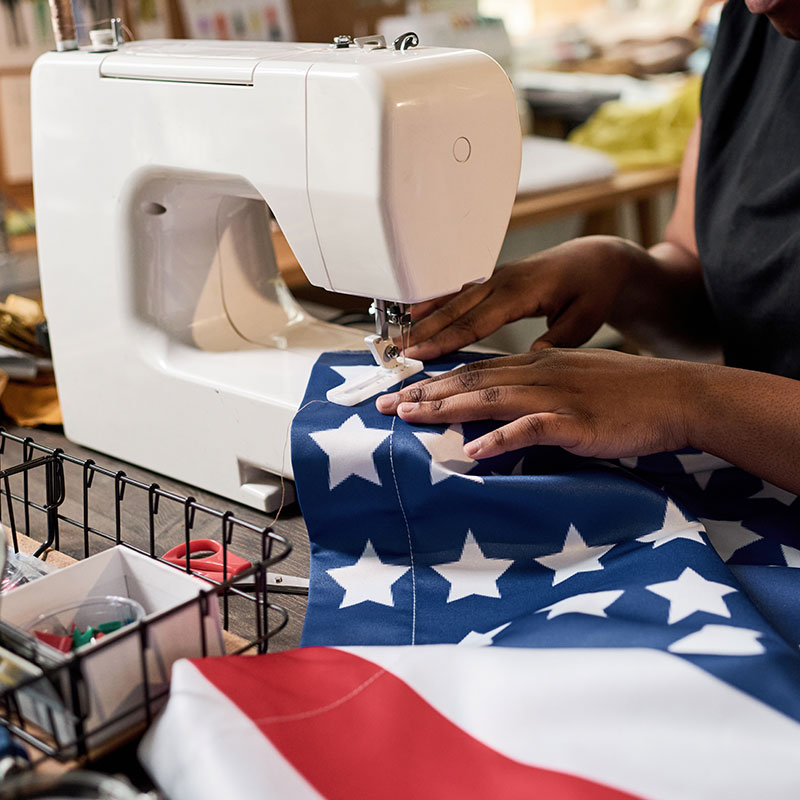
Describe color with an agreed physical reference where appearance matters. Phone photographs and screen previews depend on lighting, camera settings and displays. Ask for a fabric sample with the proposed printing or sewing process, then compare it with the reference under the same lighting. Mark the face, material and sample revision so the retained piece remains useful for later orders.
Do not promise a universal numeric color tolerance without identifying the measurement method and agreeing it with the supplier. A custom flag buyer can instead record the visual acceptance decision and request instrument data when the project needs it. Dark fabric, backing layers and transmitted light may change the perceived result, so examine the actual finished assembly rather than an isolated ink swatch.
Approve the reverse as a separate view
A single-layer flag may show a mirrored image from its reverse. Two outward-facing printed panels can provide separately readable faces, but that construction also changes weight, thickness and edge assembly. The words single sided and double sided are insufficient unless the custom flag drawing explains the intended appearance. Request front and reverse proofs with a clearly marked attachment edge.
The custom flag approval should state whether mirrored lettering is acceptable, whether symbols must face a particular direction and whether show-through is part of the expected result. For a two-panel construction, inspect both faces against a light background and at the intended display location. A correct front proof does not establish reverse readability or prove that an internal blocking layer is suitable.
Release a proof package with explicit open points
Use an approval sheet with three possible outcomes: accepted, accepted subject to listed changes, or a new sample required. List each unresolved item with its owner and next action. If the color is accepted but the reverse is not, say so. A general reply such as looks fine creates ambiguity when the drawing, sample and quotation are not identical.
The final custom flag package should contain the design master, front and reverse views, finished dimensions, construction drawing and retained sample reference. Purchasing can then compare quotations against one specification. Receiving staff can use that same package to assess what arrived, rather than trying to reconstruct the approval from a long message thread.
Separate identity displays from short promotions
A restaurant identity piece may remain relevant while a menu offer or seasonal message expires. Keep the artwork revisions and stock records separate. The manager should know which pieces are current without unfolding every package or relying on an old promotional photograph.

Resolve frontage fitting through the responsible person
Give the installer the proposed dimensions and construction along with photographs of the site. Confirm the applicable site requirements through the responsible contact. A flag supplier can confirm its product finish but cannot establish every local installation condition from a logo file.
Keep daily handling practical
Restaurant staff have other operational priorities. Provide clear orientation and storage instructions and assign who checks the custom flag display. If the operating plan calls for removal or drying, make sure there is a workable route and storage area rather than an instruction that staff cannot follow.
Compare a chain order with local site needs
A common promotion can still require different dimensions or fittings at different restaurants. Keep site codes in the variant table and pack to the agreed distribution plan. Check replacements against the current campaign revision so old messages do not reappear at individual locations.
Make the specification usable by the operating team
Make the daily operating plan feasible for site staff. Identify who checks the display, how it is removed where required and where used pieces are stored. A care instruction is ineffective if there is no practical area to dry or inspect a returned item. Keep permanent frontage identity separate from short promotional layouts so an expired campaign does not become the easiest replacement to find.
A worked artwork release decision
A restaurant chain proposes a permanent identity piece and a short promotion for the same support. The two layouts share a logo but place words differently near the attachment. Review each visible field with the actual fitting allowance. Reusing the first technical template is reasonable only after checking whether it covers a different message on the second graphic.
For custom flag, keep current-promotion and permanent-identity masters distinct in the branch register. Ask marketing to release the complete composition and site staff to confirm the interface. If the campaign changes, update the affected design code so a manager does not issue an older but still clean piece as the current promotion.
Use a release worksheet rather than a general approval
Create a custom flag line for each distinct design, size, face arrangement and attachment. On that line, identify the reference for the approved graphic revision and the evidence still required for the smallest important design feature. Use the graphic-specific review above to define the relevant observation: Keep the complete approved layout distinct from its manufacturing drawing. Keep an unresolved point visible with its owner and next action instead of turning a partial sample review into an unconditional release.
The operational handover should include a site-specific fitting sheet and a stock list for current promotions. Ask the site manager and facilities contact to confirm the part of the record they will actually use. The decision rule for this custom flag purchase is that artwork is released only after the design owner resolves the detail. Record accepted characteristics separately from outstanding questions. A later change to material, process or fitting should identify which part of this evidence must be reviewed again.
| Decision | Evidence for this project | Release boundary |
|---|---|---|
| Graphic | This order uses a customer-selected identity master and the construction confirmed for the project. | Keep the complete approved layout distinct from its manufacturing drawing. |
| Artwork Approval | a front-and-reverse proof | artwork is released only after the design owner resolves the detail |
| Operating record | a site-specific fitting sheet and a stock list for current promotions | promotional graphics may change more frequently than the frontage installation |
| Order identity | custom flag: design, size, face and fitting variant | Supplier-confirmed construction and buyer-approved reference |
For the relevant reference, see GINETEX guidance on care information for complete textile articles. Use it for its stated subject; it is not a certification of the quoted product.
Review custom flag product and service information and Kaiqun customization and wholesale services when preparing the specification.
Request a quotation
Ask Kaiqun to quote custom flag against the complete master and released variant register. Include the approved graphic revision, quantities, finished dimensions, fitting details, destination and receiving milestone. Explain the open questions about the smallest important design feature and request a sample plan with clear coverage. Confirm the proposed material, process, packing and schedule before releasing the custom flag order.
Frequently asked questions
What should I resolve first for custom flag?
For custom flag, identify the approved graphic revision and the selected design master. Keep its review separate from the operating confirmation provided by the site manager and facilities contact.
What evidence should a custom flag sample provide?
A custom flag sample should demonstrate a front-and-reverse proof. Use the product-specific checks in this guide and record which sizes or constructions the trial actually represents.
Can one custom flag approval cover all locations?
A custom flag approval can cover only confirmed common requirements. Compare the actual supports, dimensions and use, and repeat checks introduced by another variant.
How should a changed custom flag specification be handled?
Treat the affected custom flag requirement as a revision and ask what evidence must be renewed. Keep the supplier proposal and the buyer decision connected before release.
What helps obtain a precise custom flag quotation?
Send the custom flag master, variant quantities, dimensions, fitting and destination. Include the smallest important design feature, the required receiving date and the person responsible for the remaining approval.